Showing posts with label Politics. Show all posts

Friday, January 06, 2012

Presidential Candidates in Iceland seen through Vaktarinn

Icelandic Presidential flag.
Image via Wikipedia
I am not political or for that matter cannot vote in Iceland. But the current President of Iceland decided not to run for the 4th term in office. So there has been a list of candidates being circulated in Iceland in the media, I thought it would be interesting to get a summarized word cloud on each of the candidates. These word clouds were generated by Clara's media and PR brand monitoring tool Vaktarinn. I am not very good in Icelandic so I have an inherent disclaimer whatever is shown in these word clouds are what the general public sentiment is so don't shoot the messenger. In addition, I don't have any analysis to add to this.

1. Ólafur Ragnar Grímsson
2. Ragna Árnadóttir

4. Páll Óskar Hjálmtýsson
5. Jón Gnarr
6. Salvör Nordal
10. Andri Snær Magnason


Enhanced by Zemanta

Friday, December 30, 2011

Is Iceland being perceived as a just society?

Read this article in Reykjavik Grapevine, it is a finding of a study being conducted by Jón Gunnar Bernburg @University of Iceland, Berglind Hólm Ragnarsdóttir @City University of New York and Sigrún Ólafsdóttir @Boston University. The title of the paper is "Subjective Injustice during the Icelandic Recession 2009-2010" where the authors have done a survey of 948 people representing a good cross section of the Icelandic population. If you want to read the whole report you can find it here. There were a bunch of graphs that I thought were very interesting.
  • 81% of the respondents felt that it was necessary or quite important to "know the right people"!
  • 75% agree that everything is so uncertain these days that it feels like anything can happen
  • 50% think it is necessary or quite important to have political connection
  • 15% think it is important to bribe somebody
  • Over 57% of the respondents feel that their status in the society is unjust!
  • 35% feel that their standard of living will get much worse in the near future
  • 79% agree that everything is chaotic that it is difficult for people to know where they stand fro day to day
  • 37% get angry or frustrated due to their status in the society


The authors hypothesis the following from the study:
  1. We predict that under the circumstances of reduced living standards and uncertainty about future living standards individuals who have internalized high monetary goals will be more likely to experience status injustice. 
  2. We predict that individuals having expectations about their future economic status tend to exhibit more subjective status injustice, again net of their actual economic position.
  3. We hypothesis individuals who believe that the opportunities for achievement are corrupted by personal ties, political connections, or bribery will be more likely to experience subjective status injustice
  4. We expect the perception of uncertainty and instability regarding social institutions to undermine subjective status justice
I think the consequences of those experiences and perceptions are important. 
This study is quite surprising to me. What do you think? Do you think Iceland is a fair and just society? What about starting a business here?


Enhanced by Zemanta

Sunday, December 04, 2011

Euro Zone Debt Crisis

I think this picture says a lot about what is being discussed in the main stream media about the Euro Zone Crisis. High Debt to GDP is only an issue when the GDP is not growing fast enough to pay for the Debt. IMHO, that should be the discussion and not the level of debt. The second important point and I think this is more relevant that anything else is how are we going to grow the GDP? Iceland did it by devaluing their currency. How is Greece going to increase its competitiveness in the global market place? There is no short term answer, GDP growth always takes time to implement and structurally change the economy. It took India 12 to 15 years to get GDP growth at a rate that would make an impact in the economy and it took China over 25 years to attain the rate of growth of around 10%. If the political machine in Europe can implement policies that would get Europe to grow at 3 to 5% again the crisis can be averted. Of course there is going to be hick ups in the short term, it depends a lot of how bad of a hick up we have or a major heart attack. I am certain the policy decision of ECB is very important, they need to cut the interest rates to make the Euro economies to grow again and also stand behind supporting the confidence in the market. Failure to achieve either of those things we are going to have a deep and severe recession in the Euro Zone and the above Debt to GDP ratio is going to get worse.

Thursday, July 16, 2009

Policy implications if we use Power Law distribution

I have been working on my first paper with the title "Can Power Law help us avoid highly improbable tail events?" the premise of the argument is that if some economic variables fall in the Power Law distribution then policies associated with those economic variables need to be handled differently. For example, I am taking the problem of the Icelandic Krona, I have written about the Icelandic Krona before and I am convinced that it follows a Power Law distribution.

If we know that ISK follows a power law distribution and future fluctuations in ISK are going to follow the Power Law distribution should the Icelandic state still use the currency in its current form? or should it switch over to a more stable currency say the Euro? this debate is on-going in Iceland and I am afraid people are viewing this decision with their political lense and not the economic lense.

Just a simple switch in the probability distribution of the ISK has some serious policy implications. Lets do a simple thought experiment: The Financial Supervisory Authority of Iceland used a 20% devaluation of the ISK as a basis to stress test the banks in Iceland, why did they choose 20% because they thought ISK followed a Gaussian Normal Distribution and a 20% devaluation is a 2 or 3 sigma event or a very low probability of occurance, however if we change the distribution to Power Law a 20% devaluation of the ISK has a much higher probability therefore they would have chosen a much higher deviation for the stress test say 50% this would have shown the true color of the Icelandic banks capital adequacy and vulnerability to wholesale funding. The question is if the stress test had been done in 2006 when Iceland had a mini crisis, the FSA could have put a stop to the aggressive borrowing by the Icelandic banks which in turn would have reduced the leverage of the companies in Iceland and the citizens.

So choosing the right probability distribution matters! atleast that is the basis for my PhD thesis lets hope the thesis could influence some policy choices.
Reblog this post [with Zemanta]

Wednesday, May 27, 2009

The Crisis and The Response - An interesting panel debate

Here is a very interesting debate by Bill BradleyNiall FergusonPaul KrugmanNouriel RoubiniGeorge SorosRobin Wells et al.

My Summary:
1. The US banks have to be nationalized
2. We need better regulations around derivatives and bank capital norms
3. The US needs to grow through normal sustainable means like investing in technology and innovation and increasing productivity
4. The US consumer would have to scale back on their consumption and increase savings, at the same time the rest of the world needs to increase their consumption and decrease their savings
5. All the stimulus in place would have to be reversed at the first sign of reversal as it has huge implications to the US balance sheet and its credit worthiness

Monday, May 25, 2009

Icelandic Government & Choices before it & some modest suggestions...

I saw a very disturbing development in the news in Iceland, the Government is thinking of cutting cost in schools and education. This is precisely what one of the MP said that they will not do before the election, but of course they have a change of heart when they are in the Parliment.
Here is a perspective of the debate before the election, I think Icelandic government has a lot of tools in front of it to deal with the burden of debt, for example if a case could be made to the public of Iceland that a 5% increase in tax is needed to maintain and build the Education System, Infrastructure, Healthcare and Elderly care services everyone will pay up without any question. The increase in tax could be temporary, say for the next 2 years or 3 years until a majority of the burden is resolved. 
Where do I think the Icelandic government needs to cut its expenses? Here is a no-brainer:
Oil imports - put a tax on car owners and oil users, I think Iceland is small enough to provide incentives for people to switch on their mode of transportation. You can even get creative, have the tax during the summer months when the weather outside is not as bad as when it is during Winter. Almost every household that I know has atleast 2 cars, whereas you can get by with one... We have been living in Iceland for the past 3 years and we have got by with one car not because we cannot afford one! On the contrary it makes us plan ahead and coordinate our days so we can do all the things with just one car. I don't understand why this cannot be adopted in Iceland for every household. I mean if you want to own more than one car then you just pay a higher price, which I think is a fair bargain.
There were so much talk about Iceland becoming Oil independent in the past, here are all the links... 
I think Iceland will be a very interesting candidate for the Pigou Tax

Wednesday, December 20, 2006

Are all economists conservative?

Greg Mankiw has an interesting post based on a letter that he got from an economics student. My wife thinks that I tend support republican or conservative ideas, and she is a liberal a.k.a democrat. However, neither of us align with these parties. What I am able to decipher based on reading the post from Greg is why I tend to be more conservative in my thinking than most people that I speak to. I think if there is one quote that I really like is "I know what is best for me and my family, no government or union or trade association can decide that for me". I think it was Milton Friedman who said that... there is more and more evidence supporting the theories put forth by these economists.

Monday, November 13, 2006

Depressing news this morning in BBC

I was listening to BBC report that in a global scale Terrorists are winning! In Afghanistan to Iraq and America. I am quite depressed about this! What is going on? Are we such spine-less people! to let such extreme idealogies win over Freedom, Liberty, Justice and the rule of law...

Monday, October 30, 2006

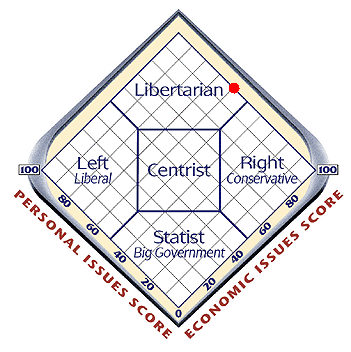
World´s smallest political quiz... try it!


I learnt about this from Gregg Mankiw's post. The diagram above shows my politics... take the quiz and see where you stand on issues.

Saturday, September 23, 2006

Framing - everyone should learn to decipher this

Greg Mankiw's Blog: Ip is caught framing.
Greg talks about how statistics and number can be "Framed" to push your cause whether political or otherwise. I think everyone should learn to read between the lines on political debates and well as companies publishing numbers, one can really play with the words and bias the conclusion.